How to Learn English with AI and Build Your Own Learning Path
Apr 25, 2026
Most people use AI to answer questions. Type something in, get something back, close the tab. That works fine. But if you want to learn English with AI in a way that builds real fluency, there is a different approach worth trying. You take the content you already enjoy, a podcast, a TV show, a movie, and you use AI to turn it into a complete set of study materials built around your interests and your goals.
In this post, I want to show you what that looks like in practice, including one experiment with Claude that surprised me, and a mini-course I built with it that you can try right now.
Why does learning from real content work better than a textbook?
Real content gives you the language people use. Idioms, cultural references, natural chunks of speech, things a textbook cannot cover because it cannot predict what you will hear in a specific podcast or show. You are already motivated because the content interests you. Most learners stop at listening, though. They hear something unfamiliar, note it down if they remember, and move on. A lot slips through.
Research on AI-mediated informal language learning shows that learners who use AI for self-directed study are drawn to its flexibility and personalization, the ability to engage with content that fits their own goals and interests. This approach gives you both. You pick the content, and AI does the heavy analysis.
What can you give AI to build your own learning materials?
Start with a transcript. Most podcasts have one, and if not, many tools can generate one. Once you have it, ask an AI to:
- Extract vocabulary organized by difficulty, with meanings and example sentences from the transcript itself
- Pull out every idiom, phrasal verb, and natural spoken chunk with context and usage notes
- Identify cultural references, jokes, and unspoken assumptions that are easy to miss
- List common collocations, words that appear together frequently in natural speech
- Generate discussion prompts so you can practice speaking about what you heard
The goal is simple: instead of only listening, squeeze everything you can from the content. You still do the listening. But then you go a step further and use AI to catch what you missed.
You can do this with any chatbot by pasting a transcript directly. But one tool goes further in a way worth paying attention to.
What can Claude Cowork do that other AI tools cannot yet?
Claude Cowork reads a file from a folder on your computer, builds new study materials from it, and saves them back into the same folder. You start with a transcript and a prompt, walk away, and come back to finished files. No uploading, no downloading, no copying between tabs.
I ran the same experiment with two tools: Google Gemini's personal intelligence feature and Claude Cowork. Both had access to a folder containing a podcast transcript. The task was identical: create six files from the transcript, a vocabulary spreadsheet plus PDFs covering idioms, cultural notes, collocations, and discussion prompts.
Gemini found the file in my Google Drive without trouble. But at the time of testing, it could only read files, not create new ones. It produced the analysis, but I had to copy everything out manually. That limits its usefulness. What makes AI powerful for a task like this is not finding information; it is creating something new with it.
Claude Cowork created all six files and saved them into the folder. Five minutes later, they were there. The vocabulary spreadsheet was organized into beginner, intermediate, and advanced sections, each entry with the word, its meaning, the exact line from the transcript, and an original example sentence. The cultural notes file detailed how American office culture handles pranks, drawing on specific scenes from a clip discussed in the episode. The discussion prompts were substantive, not filler.
What struck me was not the quality alone. It was the workflow. I started with a transcript and a prompt. I walked away. I came back to a folder of ready-to-use study materials. That is a different kind of experience from copy, paste, upload, download. It feels like something new. That same principle works in a different direction too, using a feature like claude artifacts starting with your own materials.
How can I build my own English mini-course with Claude?
Ask Claude to build it. Describe the topic, the format you want, and how you want it organized. Claude will produce a structured, interactive lesson you can use immediately. The prompt does not need to be long; it needs to be specific.
I asked Claude to create a visual mini-course on workplace English phrases. I told it I wanted pagination, clear examples, a course overview first, then individual lessons, and a minimal but friendly design. Claude built it in one go. The result is embedded below. Try it here.
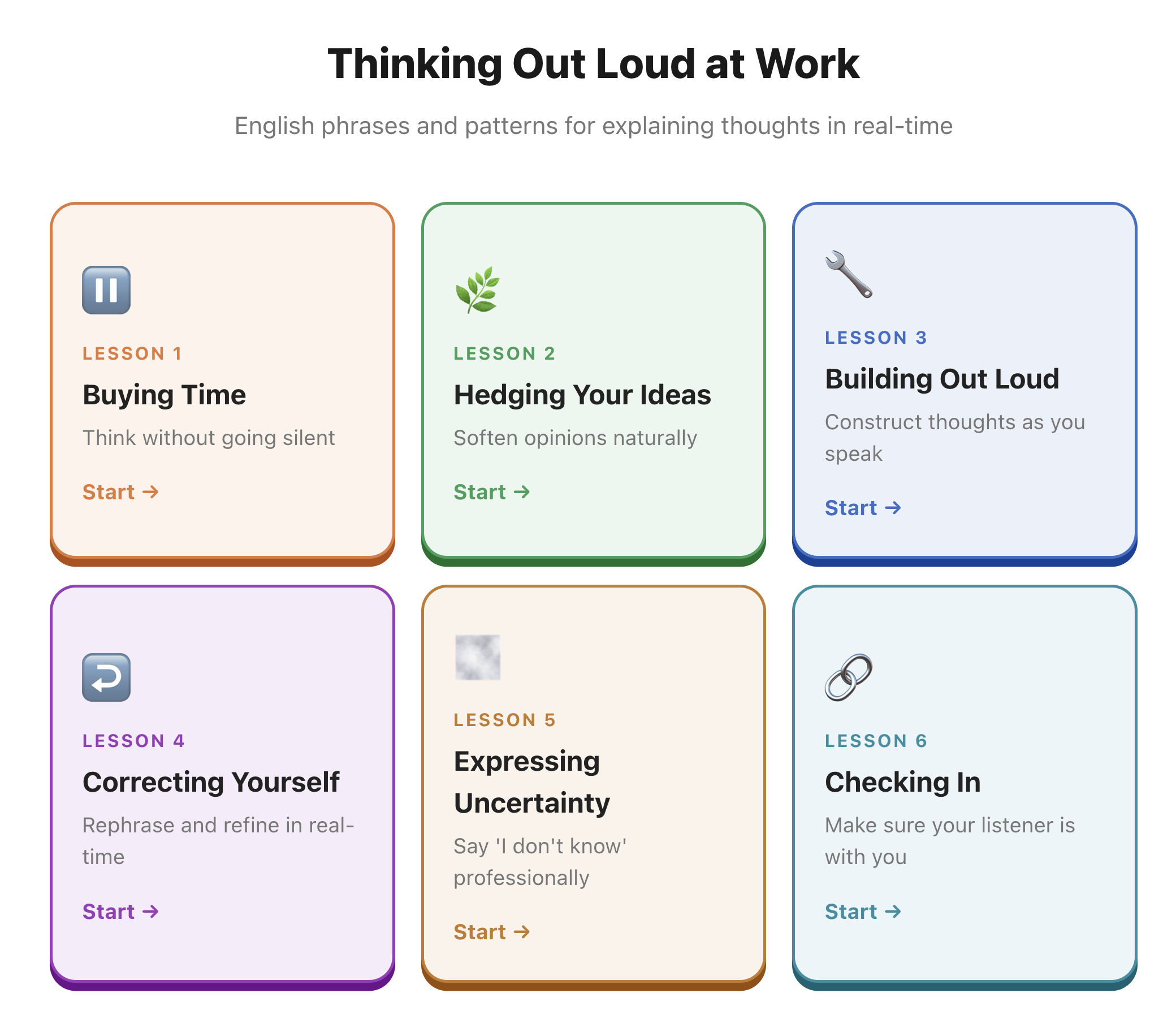
The same approach works for grammar patterns, vocabulary sets, pronunciation practice, or any topic you want to turn into a structured lesson. You describe what you want, and Claude builds it.
Be specific with your prompt. Tell it the topic, the format, the learner's level, and how you want it organized. The clearer your description, the better the result.
Frequently Asked Questions
What kind of content works best as a starting point?
Anything with a transcript or clear audio works. Podcasts are ideal because they are conversational and full of natural speech. TV shows, interviews, YouTube videos, and meeting recordings all work. The more unscripted the content, the richer the language material you get from it.
How is this different from using a language learning app?
Apps give you their content. This approach lets you learn from your content. If you already watch a show you enjoy or listen to a podcast in your field, that becomes your classroom. The vocabulary and expressions you study come from something meaningful to you, which makes them easier to remember and more likely to come up again in real conversations.
Ready to build your English fluency with a clear plan?
Experimenting with AI tools helps you find what works for you. If you want a structured path alongside the experimenting, my 90-day program gives you a day-by-day system built around daily practice and AI tools. Take a look at English Fluency in 90 Days and see if it is the right fit for where you are now.